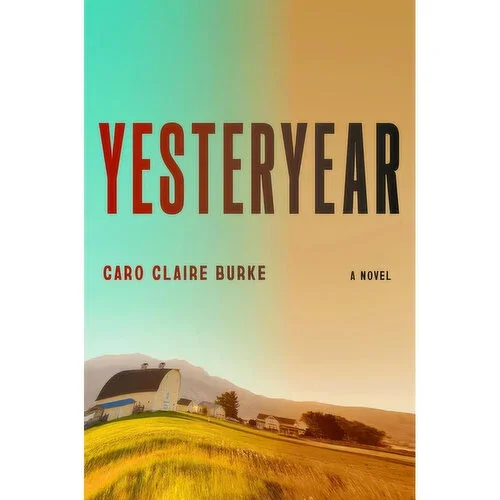
“Yesteryear” by Caro Claire Burke
August 19, 2026
“Now the Lord wants me to feel the truth of my own message” (p.112)
Natalie Heller Mills built an empire on raw milk, curated social posts, and an excess of lies. Her not-so-traditional business sells a fantasy of a traditional, pre-modern woman to millions of digital viewers – just one perfectly lit sourdough at a time.
The premise alone is bizarre, but Burke commits fully to it. The story takes an almost Shyamalan-esque turn, connecting Natalie’s present-day life to the year 1805 in a way that is strange enough to make you question where the book is going, but entertaining enough that you keep reading to find out. I was not always sure how I felt about the explanation toward the ending, but I still enjoyed the journey there.
I think this book was a karmic story and a particularly fitting one given the rise of the “tradwife” phenomenon in North American media. The book takes the familiar cultural fantasy that glamorizes the past and essentially asks: what if we actually tested that theory? Natalie spends her life selling an idealized version of the past, only to find herself forced to live in the truth behind the fantasy she created.
That punishment is perhaps the most fitting part of the story. Natalie has to live without the cameras, the flashing lights, the producers, the scripts, and the social media platforms. She is forced to practice what she preaches, rather than perform it for an audience. The perfectly curated Instagram post is replaced by the reality behind it, which is the dirty, exhausting, uncomfortable, and sometimes unhappy parts that never make it onto the screen.
This is also where the book’s characters become particularly interesting. There are very few, if any, genuinely good people. Natalie is deeply unhappy, living a lie and eventually becoming comfortable within it. Her husband is weak, spoiled, and immature, seemingly incapable of taking responsibility for either his family or the political baggage attached to it. Her sister Shannon is no better. She may appear to be more perceptive than Natalie, but she is ultimately constructing her own curated version of reality because she exposes one fraud while comfortably maintaining another.
In that sense, no one really wins. The picturesque metaphor begins to crumble, along with the home, business, relationships, and lives built around it. And perhaps that’s the point; the past was never as perfect as Natalie wanted everyone to believe.