Moral Rights in Canada: The Legal Limits on Altering Art
January 1, 2026
In Canada, moral rights are a specific set of rights granted to creators under the Copyright Act. They are distinct from economic (financial) copyright rights and are meant to protect the creator’s authorship.
What Moral Rights Protect
Canadian law recognizes three moral rights:
Attribution gives authors the right to be identified as the creator of a work or not to be identified at all. An author may insist on having their name attached, remain anonymous, or use a pseudonym. The choice belongs to the creator, not the owner or publisher.
Integrity allows an author to object to changes made to their work. The legal question is whether it is prejudicial to the author’s reputation. This protection applies most often to artistic, literary, musical, and dramatic works and extends to physical modifications and contextual uses.
Association, sometimes described as the right against false association, protects authors from having their work linked to a product, service, cause, or institution in a way that damages their reputation. Even unchanged works can trigger a violation if the surrounding context harms the author’s standing.
Moral rights belong only to the author. They cannot be assigned or sold, even if they transfer the copyright. While authors may waive moral rights, the waiver must be explicit and is typically set out in writing.
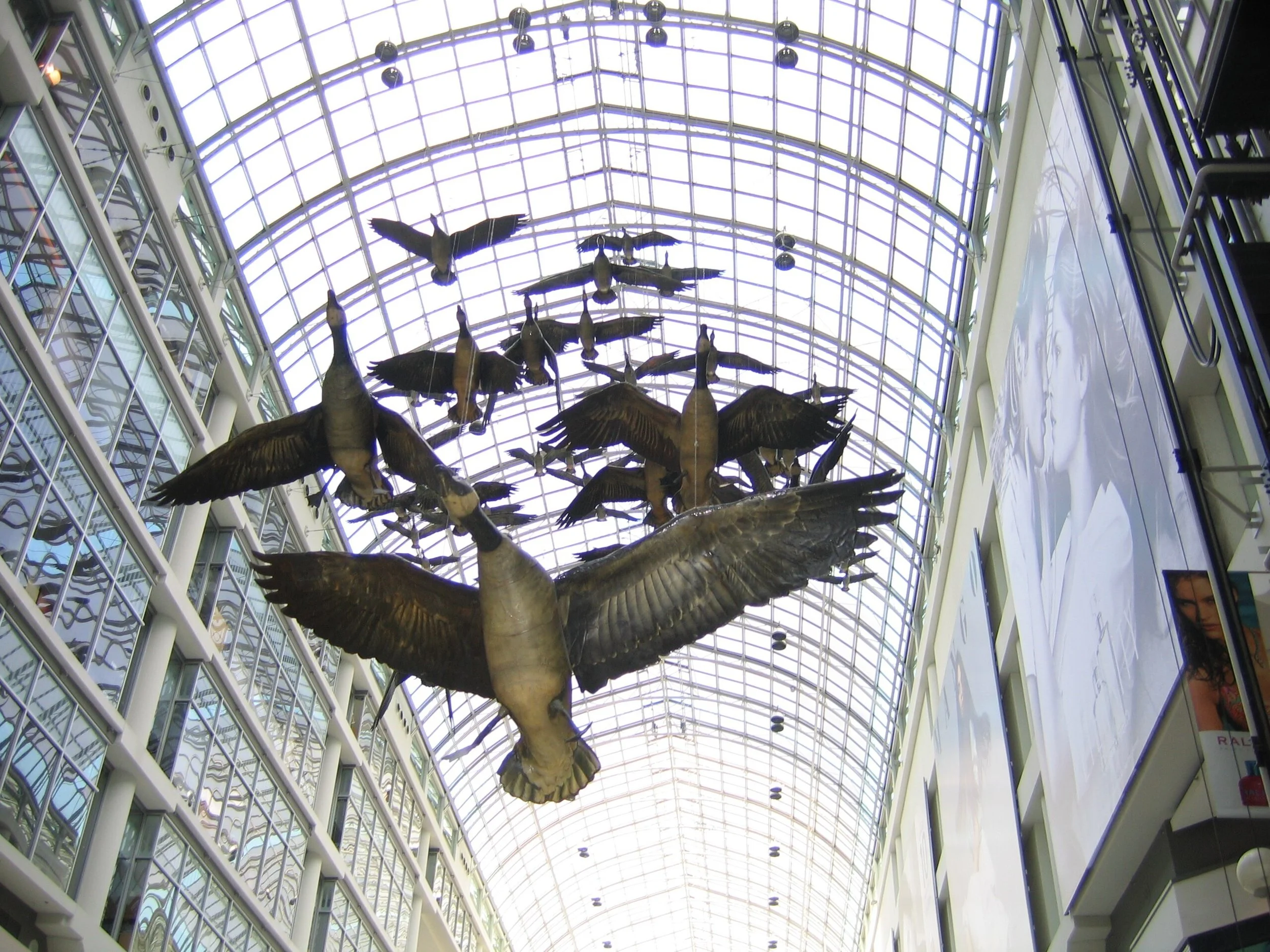
Image courtesy to Wikipedia.
A clear example is Snow v. Eaton Centre Ltd (1982).
Michael Snow created a sculpture of flying geese for the Toronto Eaton Centre. During the holiday season, the mall tied red ribbons around the geese. Snow objected because the ribbons altered the meaning of his work and reflected on his reputation.
The court agreed, ruling that moral rights belong to the author, not the owner, and that even minor or temporary changes can violate those rights if they prejudice an artist’s honour or integrity.
Four decades later, the case still remains a benchmark in Canadian law.